Choosing the Right 360 Prism for Robotic Total Stations
A comparison of 360-degree prism options for robotic total stations, covering prism constants, tracking range, and compatibility considerations.
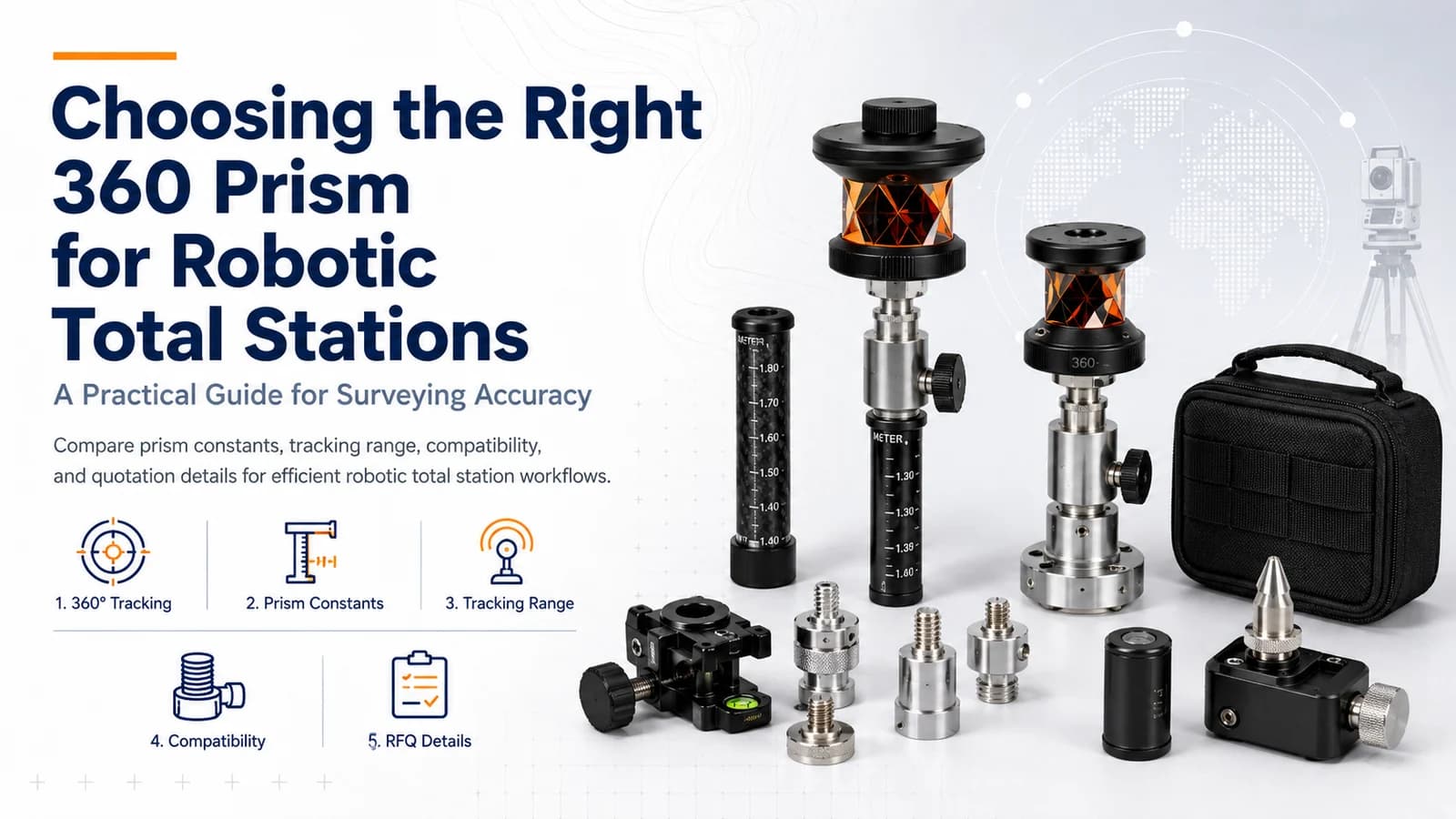
360-degree prisms are essential for robotic total station workflows, allowing the instrument to track the prism from any direction without manual rotation. Choosing the right prism affects measurement accuracy and field efficiency.
How 360 Prisms Work
A 360 prism uses multiple corner cube reflectors arranged in a ring, returning the signal regardless of horizontal orientation. This enables continuous robotic tracking as the surveyor moves between points.
Prism Constants
360 prisms typically have a prism constant of 0mm or -30mm. The correct constant depends on your total station model and must be configured in the instrument settings. Using the wrong constant introduces systematic errors.
Tracking Range
Tracking range varies by prism quality and instrument power. High-quality prisms support tracking up to 800 meters or more in good conditions. Environmental factors such as fog, rain, and heat shimmer affect range.
Compatibility
360 prisms use standard 5/8x11 mounting threads, making them physically compatible with most range poles. However, prism constant settings vary by instrument brand. Always confirm the exact model of your total station before ordering.
Requesting a Quotation
When submitting an RFQ for a 360 prism, include your total station make and model so our team can confirm the correct prism constant and compatibility.